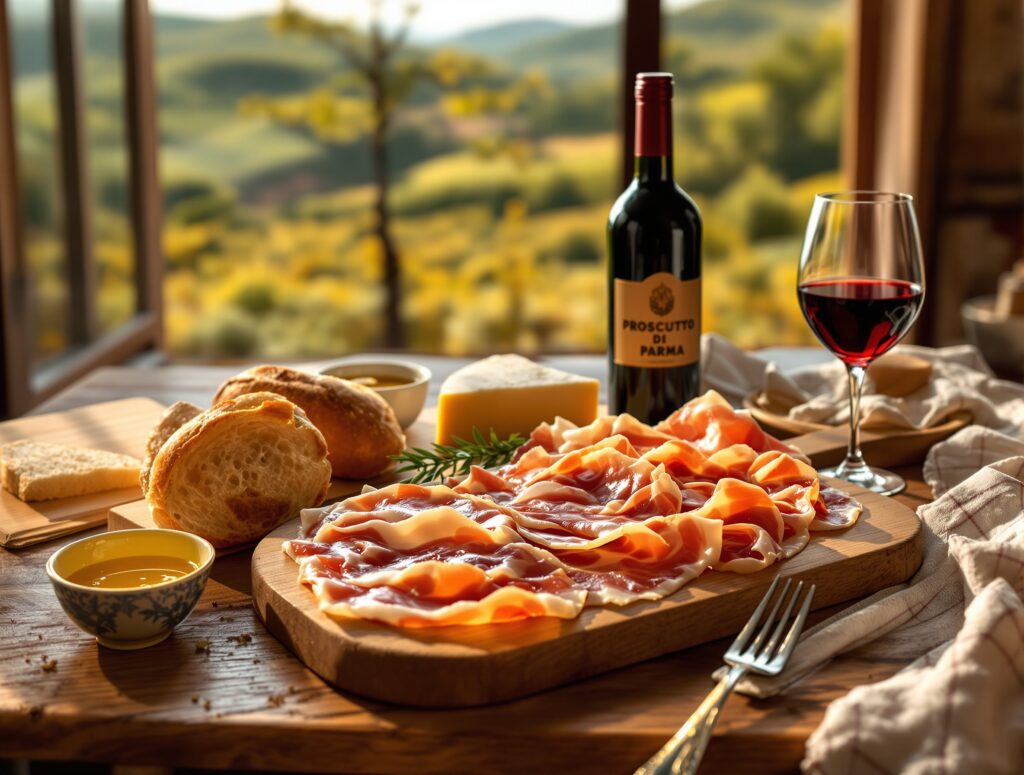
Italian Prosciutto di Parma, hailing from the Parma region, is a cherished gem of Italy’s culinary heritage. Renowned for its sweet and subtle flavor, this traditional ham is crafted using time-honored techniques passed down through generations. Its exceptional quality and authenticity are deeply rooted in a meticulous production process that harmonizes with the natural environment of Emilia-Romagna while honoring age-old traditions.
This celebrated delicacy is not only prized for its exquisite taste but also admired as a testament to Italian tradition and artisanal skill. Its preparation, though seemingly simple, relies on precision and care, utilizing just two key ingredients:
- premium pork from specially raised pigs,
- natural sea salt.
The curing process leans entirely on nature—airflow, salt, and patience—to achieve its signature flavor profile.
A staple in Italian cuisine, Prosciutto di Parma lends its distinctive sweetness and velvety texture to countless dishes. Whether delicately sliced for a charcuterie board or paired with fresh fruits like melon or figs, it effortlessly elevates any dining experience. With its Protected Designation of Origin (PDO) status safeguarding its authenticity, Prosciutto di Parma remains a shining symbol of excellence in Italian gastronomy.
The Rich History and Tradition of Prosciutto di Parma
The story of Prosciutto di Parma dates back to the Etruscan era, making it one of Italy’s most treasured and ancient culinary traditions. Over time, the art of pork butchery in the Parma region evolved into a highly sophisticated craft. This transformation laid the foundation for curing processes that are still practiced today. Far from being just a delicacy, this ham embodies Italian heritage and exceptional craftsmanship.
Its significance is deeply connected to advancements in agriculture across central-northern Italy. Progress in cereal and dairy farming bolstered pig breeding, which in turn led to increasingly refined methods over generations. These age-old practices are carefully protected by strict regulations designed to uphold authenticity and maintain quality.
Beyond its exquisite taste, Prosciutto di Parma carries profound cultural importance as a representation of artisanal skill. Families have meticulously preserved these traditional techniques through countless generations, ensuring their legacy endures. Each slice tells a story of dedication, tradition, and mastery. It’s no surprise that Prosciutto di Parma remains a timeless symbol of Italy’s rich culinary artistry and heritage.
What Makes Prosciutto di Parma Authentic?
The distinctiveness of Prosciutto di Parma lies in its adherence to strict production standards and a commitment to time-honored methods. It is crafted exclusively from the hind legs of select heritage pig breeds, such as Large White, Landrace, or Duroc. These pigs are raised in Emilia Romagna and fed a carefully controlled diet enriched with whey derived from Parmigiano-Reggiano cheese, which imparts the ham’s characteristic nutty-sweet flavor.
No artificial additives or preservatives are ever introduced during production—only sea salt is used for curing. This dedication ensures the ham remains completely natural. The process relies on traditional practices and the region’s unique climate to achieve proper curing and aging.
- every ham undergoes meticulous inspections,
- only those that pass earn the prestigious Parma Crown mark,
- Parma Crown mark is a fire-branded symbol of authenticity and tradition that guarantees its genuine origin.
Protected Designation of Origin (PDO) Status and Its Significance
The Protected Designation of Origin (PDO) label for Prosciutto di Parma guarantees its authenticity, exceptional quality, and adherence to time-honored production techniques. This prestigious certification restricts the creation of this iconic ham exclusively to Italy’s Parma region. The area’s distinctive climate and geography play a crucial role in shaping the flavor and character of this delicacy. PDO status ensures that every step, from selecting the raw materials to curing and aging, complies with strict standards established by the Consorzio del Prosciutto di Parma. This not only safeguards its originality but also upholds a rich cultural legacy.
By preventing counterfeits and enforcing rigorous quality requirements, the PDO designation fosters consumer confidence. It assures buyers that Prosciutto di Parma adheres to specific criteria, such as:
- using heritage breed pigs from approved regions,
- feeding these pigs a carefully managed diet enriched with Parmigiano-Reggiano whey,
- permitting only natural ingredients like sea salt during production.
Each ham is meticulously inspected before earning the iconic Parma Crown mark, confirming its genuineness. Through these measures, the PDO designation plays an integral role in preserving Prosciutto di Parma’s worldwide reputation for excellence. It also bolsters local economies while protecting centuries-old traditions rooted in Emilia-Romagna’s unique heritage.
Why Prosciutto di Parma Can Only Be Made in Parma
Prosciutto di Parma owes its distinctive qualities to the province of Parma, where a unique microclimate provides perfect conditions for curing and aging. The interplay of sweet, dry air descending from the Apennine Mountains and breezes rolling in from the Ligurian Sea creates an environment that simply cannot be duplicated elsewhere. These natural elements play a vital role in developing the ham’s renowned flavor and texture.
To carry the prestigious Protected Designation of Origin (PDO) certification, every stage of production must take place within this specific region. This ensures that each piece benefits fully from these exceptional environmental factors while maintaining its authenticity and high standards. The delicate balance of nature, time, and tradition makes Parma indispensable in producing this globally celebrated delicacy.
The Role of Heritage Breed Pigs in Prosciutto di Parma
Heritage pig breeds like Large White, Landrace, and Duroc play an essential role in crafting the renowned Prosciutto di Parma. These specific breeds are chosen with care to meet the rigorous standards that define this celebrated ham. Raised in Italy’s Emilia Romagna region, their growth is meticulously supervised.
What the pigs eat has a profound impact on the final flavor of Prosciutto di Parma. Their diet often includes whey derived from Parmigiano-Reggiano cheese production, which imparts a subtle nutty sweetness to the meat. To ensure exceptional quality, these pigs are required to reach certain benchmarks:
- typically around nine months old,
- weighing approximately 160 kg,
- maintaining exceptional health and care.
Selecting these heritage breeds underscores a dedication to preserving tradition and achieving excellence. Their distinct genetics, coupled with precise breeding techniques and a carefully curated regional diet, play a pivotal role in creating the ham’s signature texture and flavor. This thoughtful approach guarantees that only the finest pork becomes part of this iconic Italian specialty.
How Sea Salt, Air, and Time Create the Perfect Ham
The art of crafting Prosciutto di Parma hinges on a harmonious combination of sea salt, air, and patience. Sea salt acts as a natural preservative, drawing out moisture while subtly enhancing the pork’s inherent sweetness without overwhelming it. The unique air of Parma, infused with dry, fragrant breezes from the Apennine Mountains and Ligurian Sea, plays an equally vital role. It ensures consistent drying and contributes to the ham’s signature aroma.
Time is just as crucial in this process. A minimum of 14 months of aging allows enzymes to work their magic, developing the intricate flavors that give this delicacy its refined taste. This extended curing period creates a perfect balance of sweet and savory notes while ensuring a tender texture that practically melts in your mouth. All these elements are brought together through time-honored techniques, resulting in Prosciutto di Parma’s unparalleled quality and authenticity.
The Unique Production Process of Prosciutto di Parma
The making of Prosciutto di Parma is a meticulous process rooted in tradition and care. It begins with the careful selection of premium pork from heritage breeds such as Large White, Landrace, or Duroc. These pigs are exclusively raised in specific Italian regions and fed a regulated diet that includes whey from Parmigiano-Reggiano cheese, which contributes to the ham’s distinct nutty-sweet flavor.
Once the finest pork legs are chosen, they go through an essential salting phase:
- natural sea salt is applied to draw out moisture,
- preserves the meat without relying on artificial additives,
- lays the foundation for the rich flavors that define this delicacy.
The salted legs are then stored at cool temperatures, giving time for the salt to deeply infuse, enhancing both texture and taste.
Following salting, the hams are thoroughly washed and left to dry under carefully controlled conditions. At this stage, Parma’s unique climate plays a crucial role. The dry, sweet air descending from the Apennine Mountains aids in consistent drying while imparting regional characteristics that make this ham so special.
The next step is curing in cellars where the hams age for no less than 14 months—and up to 36 months for select premium varieties. During this extended aging process:
- natural enzymes work within the meat to break down proteins and fats,
- results in Prosciutto di Parma’s signature tender texture,
- creates intricate, layered flavors.
Each stage of production is subject to rigorous quality checks. Before receiving the prestigious Parma Crown mark—a guarantee of authenticity and excellence—every ham undergoes thorough inspection.
This artisanal approach illustrates why Prosciutto di Parma stands among Italy’s most revered cured meats. By blending natural ingredients like sea salt with time-honored techniques and harnessing Emilia-Romagna’s distinctive environment, it achieves a level of quality and taste celebrated across the globe.
The Aging Process: From Fresh Pork to Delicate Flavor
Transforming fresh pork into the savory treat that is Prosciutto di Parma requires a careful and deliberate aging process. This journey spans at least 12 months, though some hams are left to mature for as long as 36 months, allowing their flavors to grow more intricate. During this period, natural enzymes work their magic, breaking down proteins and fats to create the ham’s signature taste.
The unique climate of the Parma region is crucial in this transformation. Its specific blend of temperature and humidity ensures the ham loses moisture slowly while maturing evenly. Over time, the meat develops a tender texture paired with a sophisticated flavor profile that perfectly balances sweetness with savory notes. This age-old tradition highlights how patience and precision are key to achieving the exceptional quality of Prosciutto di Parma.
What Sets Prosciutto di Parma Apart from Other Cured Meats?
Prosciutto di Parma stands out among cured meats thanks to its rich flavor, time-honored production methods, and dedication to authenticity. While many other cured meats rely on artificial additives or preservatives, this Italian delicacy is crafted using only natural sea salt and the distinctive climate of the Parma region, resulting in a product that remains entirely natural.
The pigs used for Prosciutto di Parma are a heritage breed raised on a specialized diet enriched with whey from Parmigiano-Reggiano cheese. This unique feeding practice imparts the ham’s signature nutty-sweet flavor. Adding to its exclusivity is the PDO (Protected Designation of Origin) certification, which mandates strict adherence to regional production standards. Only hams produced entirely within the Parma region earn this prestigious designation.
Aging plays a crucial role in developing its exceptional taste and texture. The process lasts a minimum of 12 months but can extend up to 36 months for premium varieties. Over time, natural enzymes enhance both the texture and flavor, creating a delicate balance of sweetness and savory depth. These qualities make it an ideal choice for charcuterie boards or any dish requiring top-tier dry-cured ham.
Additionally, each piece is marked with the iconic fire-branded Parma Crown as a seal of quality and authenticity. The blend of artisanal craftsmanship and Italy’s rich culinary tradition has cemented Prosciutto di Parma’s status as one of the most revered foods around the globe.