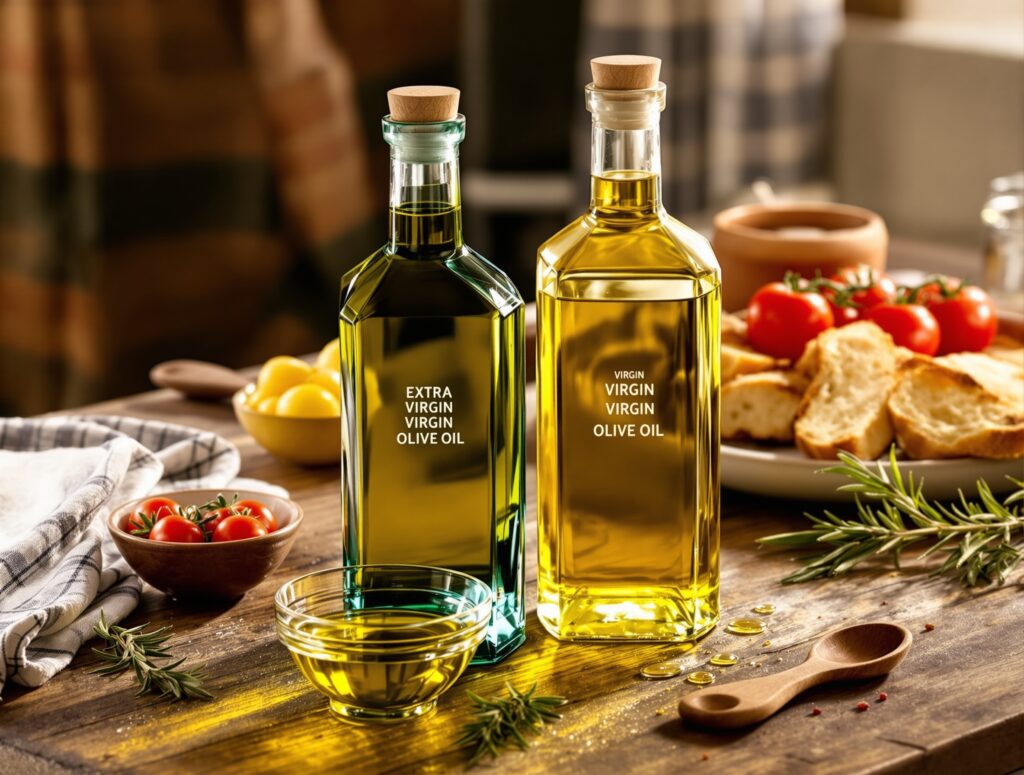
People often assume “virgin” means “nearly extra virgin.” It doesn’t—it’s a separate grade with measurable standards.
The gap comes down to how clean the oil is at pressing time and how it scores for defects and free fatty acidity, which shapes flavor, aroma, and value.
One small choice can flip the grade: tiny processing decisions can move an oil from one tier to the other.
Extra Virgin Olive Oil is often made from fresher, better-handled fruit, while Virgin Olive Oil can show slightly more sensory flaws and may taste less vibrant.
Many producers emphasize harvest timing and fast milling because delays and poor handling can raise free fatty acidity and increase sensory defects—factors that can keep an oil from qualifying as extra virgin.
main differences between extra virgin and virgin olive oil
Extra Virgin Olive Oil and Virgin Olive Oil separate at the quality line: extra virgin has tougher sensory rules and a lower acidity limit. That shows up in the mouth—extra virgin tends to taste clean and fresh, while virgin may carry mild defects and a heavier feel.
Two labels. Two standards. So what does that look like in the bottle—and on your plate?
what defines extra virgin olive oil
Extra Virgin Olive Oil sits at the top of the grading ladder, with no sensory defects and a maximum free fatty acidity of 0.8% (as oleic acid) under widely used international standards.[1] That number isn’t branding—it’s a cutoff used in major trade standards. Timing and handling matter—milling sooner after harvest and avoiding damaged fruit can help keep acidity and defects low.
what defines virgin olive oil
Virgin Olive Oil also comes from olives without chemical refining (it is mechanically extracted), but the rules allow more sensory imperfections and a higher acidity ceiling.[1]
Expectations often snap here—virgin can still taste good, just under looser standards. Virgin Olive Oil can make sense when you want clear olive character for less money, though it’s often less sharp and peppery than a fresh-pressed extra virgin.
how acidity levels differ between the two
Acidity draws a common line in standards: Extra Virgin Olive Oil tops out at 0.8% while Virgin Olive Oil can reach 2.0%.[1] These numbers can reflect fruit condition and handling, but they don’t tell the whole story—grading also depends on sensory evaluation (defects and fruitiness), not acidity alone.[1]
| Feature | Extra Virgin Olive Oil | Virgin Olive Oil |
|---|---|---|
| Max acidity (common standard) | 0.8% | 2.0% |
| Typical taste | Cleaner, brighter | Milder, can be less crisp |
| Defects allowed | None (sensory) | Some (sensory) |
If you want the strictest bar and the lowest acidity, extra virgin is usually the safer pick. Virgin often gives up some precision for price and flexibility—one trade that’s easy to miss until you taste them side by side.
Try them back-to-back. The difference lands fast.
production processes of extra virgin and virgin olive oil
Both extra virgin and virgin olive oil begin with the same fruit and are made by mechanical extraction. They split on fruit quality, processing hygiene, temperature control, and storage—and on whether the oil can pass sensory and chemical limits for a given grade.
Labels are loud. Process is louder. What’s really in the bottle?
how cold pressing creates extra virgin olive oil
Cold pressing (often used loosely on labels) generally refers to mechanical extraction with temperature kept low to preserve aroma and reduce oxidation. You can smell the difference. Less heat and less oxygen exposure usually keep more of what your nose and tongue pick up. When fruit quality and handling stay tight, the oil is more likely to meet extra virgin’s sensory and chemical requirements.
what refinement process means for virgin olive oil
Refining is not part of virgin olive oil production. Virgin and extra virgin are mechanically extracted and not chemically refined.[1]
Refining applies to separate categories such as refined olive oil and blends sold as “olive oil” (often a blend of refined olive oil with some virgin/extra virgin for flavor). These products are designed to be milder and more consistent, but they’re labeled differently from virgin grades.
role of chemical refining in virgin olive oil production
Chemical refining does not produce “virgin” olive oil. Instead, it is used to turn lower-quality oils (e.g., lampante) into refined olive oil, which may then be blended with virgin/extra virgin and sold as olive oil (sometimes called “pure” olive oil in retail contexts).[1] Refining can reduce aroma-active compounds and typically lowers phenolic content, which can make the oil taste smoother and less complex.
- Extra virgin and virgin: mechanically extracted; graded by sensory evaluation plus chemical parameters.
- Refined olive oil: chemically refined to remove defects and create a neutral base.
- “Olive oil”/“pure” (common retail term): often a blend of refined olive oil with some virgin/extra virgin for flavor.
When a label says “virgin,” the practical question is simple: is it a mechanically extracted virgin-grade oil that meets the sensory and chemical limits? For refined or blended products, look for wording like “refined olive oil” or simply “olive oil.”
Read the back label. It helps.
nutritional and sensory qualities of extra virgin versus virgin olive oil
Extra virgin olive oil often brings stronger flavor and more consistent sensory quality than virgin olive oil because the standards are tighter. Virgin olive oil can still work well as a cooking fat, but the experience can vary more because the rules allow more wiggle room.
Consistency matters. Taste matters too. Do you want intensity and consistency, or softness and flexibility?
importance of polyphenols and oleic acid
Oleic acid is the main monounsaturated fat in olive oil and a reason many kitchens treat it as an everyday staple. Polyphenols are plant compounds that drive sensory intensity (bitterness and pepperiness) and are often used as a measurable marker associated with fresher, less-processed oils.
It’s not abstract chemistry—polyphenols are one reason a good oil can sting a little at the back of your throat.
how antioxidants affect taste and health benefits
Natural antioxidants and polyphenols shape olive oil’s smell and taste. When those compounds drop (from age, heat, light, oxygen exposure, or refining), the oil often tastes flatter.
A mild oil can be pleasant; it can also be quiet. Quiet isn’t always bad. It’s just different.
differences in flavor and aroma profiles
Extra virgin olive oil often tastes greener and more aromatic, while virgin olive oil usually lands softer and less layered. If you’re choosing for measurable compounds, extra virgin often (not always) has higher phenolic content than virgin, but it varies by cultivar, harvest timing, and storage.
- Extra virgin fits dishes where pronounced aroma and a more predictable sensory profile matter.
- Virgin fits cooking where a softer taste is preferred and more variability from bottle to bottle is acceptable.
- If a product tastes unusually neutral, it may be older, poorly stored, or a different category (like refined/blended “olive oil”).
The punch of extra virgin isn’t only preference—it can hint at a higher concentration of compounds linked to freshness. Small sensory cues—bitterness, pepperiness, fresh-cut notes—often track with what’s still inside the oil.
Taste it plain once. You’ll learn fast.
grades and classifications of olive oil
Olive oil grades tell you how the oil was made and how likely it is to taste fresh. The everyday split is practical: extra virgin/virgin oils versus oils that need refining before they’re pleasant to eat.
Shelf chaos fades. The logic is there—once you know what to look for.
overview of different olive oil grades
Extra virgin olive oil is the top grade for direct consumption: it must have no sensory defects and must meet chemical limits (including acidity).[1] Virgin olive oil is also mechanically extracted but can have some defects and a higher acidity limit.[1] Below that, lampante (not fit for direct consumption) is typically refined into refined olive oil, which may be sold on its own or blended and sold as olive oil.[1]
how grades are measured by polyphenols and oleic acid
Grades are not measured by polyphenols and oleic acid alone. In widely used standards, grading relies on sensory panel evaluation (defects and fruitiness) plus chemical parameters (including free fatty acidity and other oxidation markers).[1]
“Defects” are specific off-notes such as rancid (oxidation), fusty (fermentation in piled olives), musty (mold), and winey-vinegary (fermentation/acidic notes). Storage factors—heat, light, and oxygen—can increase these problems over time.
what regular quality olive oil is
Regular quality olive oil in many supermarkets is often a refined/blended product labeled simply as olive oil (or sometimes “pure” olive oil). It’s refined for consistency, not character, and tends to be milder than extra virgin.
Consistency is the goal—yet the flavor bill still comes due.
how to choose: a quick decision checklist
- Finishing (salads, dips, toast): choose extra virgin for aroma and peppery/green notes.
- Sautéing and everyday cooking: extra virgin or virgin both work; pick based on flavor preference and budget.
- Baking: a milder virgin or a refined/blended “olive oil” can be useful when you don’t want strong olive flavor.
- Freshness: look for a harvest date or best-by date; fresher oils are more likely to taste vibrant.
- Storage: buy in dark glass or metal, keep it cool and away from light, and close the cap tightly.
- If it tastes flat or stale: it may be old, heat-damaged, or a different category than you expected.
[1] International Olive Council (IOC), Trade Standard Applying to Olive Oils and Olive-Pomace Oils (definitions, sensory requirements, and chemical limits including free acidity for extra virgin and virgin; and categories such as refined olive oil and olive oil blends).