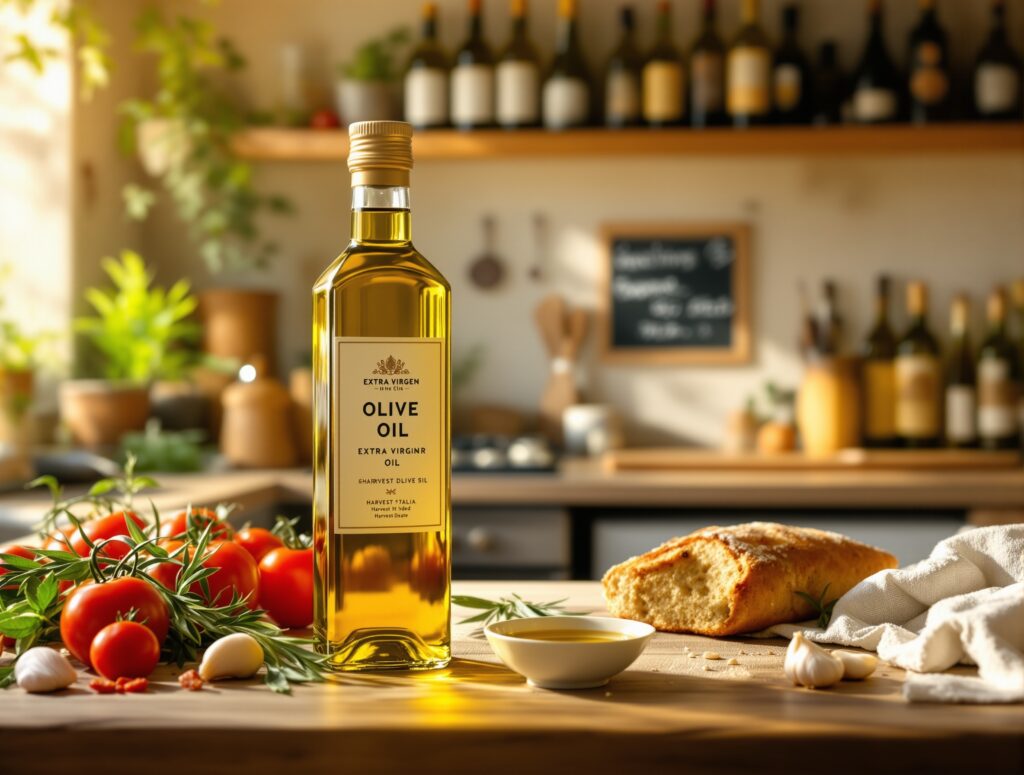
Contrary to what many shoppers assume, “extra virgin” printed on the front label doesn’t guarantee quality—or even the right grade.
A fast way to buy “like in Italy” is to treat olive oil as perishable: look for a clear harvest date, confirm origin details, and tune out marketing lines that don’t map to measurable standards.
Practical signals—PDO markings and credible independent testing programs, for example—can help you separate fresher, polyphenol-rich oils from bottles that are old, poorly stored, or simply mislabeled on supermarket shelves.
How to Identify High-Quality Extra Virgin Olive Oil
Spotting high-quality Extra Virgin Olive Oil comes down to freshness, protective packaging, and a label that actually tells you something—not bold “extra virgin” claims.
EVOO is fruit juice, not a pantry trophy. It degrades over time, and the rate depends on storage and handling. Start with the harvest date, then choose a bottle that blocks light—dark glass or metal does that job.
And here’s the snag: most labels look “premium,” yet many don’t reveal much about how fresh the oil really is.
What Are the Key Indicators of Authentic Extra Virgin Olive Oil?
Polyphenols are natural compounds in olives; they create bitterness and that peppery “kick,” so a flat, only-sweet taste can point to older oil or lower-quality blends.
Third-party programs and certifications can add accountability beyond brand marketing, which matters because some supermarket oils are described incorrectly.
Use the harvest date as a strong filter: many producers and tasters treat EVOO as best when used relatively soon after harvest, and quality often declines with time even when the bottle shows a later “best by” date.
How to Read and Understand Olive Oil Labels
Read labels like a checklist, not a story. “Packed in Italy” may describe bottling only, not where the olives were grown, while a named region/estate is typically more specific.
Treat “best by” as a storage estimate, not a freshness promise; and prefer packaging that limits light exposure.
- Harvest date: present and as recent as practical; often more useful than “best by.”
- Origin clarity: a stated region/estate; be cautious with “packed in” language without olive-growing origin.
- Packaging: dark glass or metal; skip clear bottles sitting under strong store lights.
- Accountability: a recognizable certification or independent testing program when it’s clearly explained (who tests, what standard, and how often).
If the label won’t tell you when the olives were picked and where they were grown, the purchase becomes a gamble instead of an “Italian-style” choice built on facts.
Choosing the Best Brand of Extra Virgin Olive Oil
The best brand of extra virgin olive oil is the one that makes freshness and origin easy to verify, uses protective packaging, and delivers a lively bitter/peppery profile rather than a bland, flat taste.
Extra virgin olive oil comes from pressing fresh olives without heat or chemicals, so brand quality often shows up in how tightly the producer controls harvest timing, milling, and bottling—steps that can leave a paper trail.
What explains the difference? Do you see checkable data, or just a story?
What Brands Offer the Highest Quality Extra Virgin Olive Oil?
Start with producers who publish harvest date, olive varieties, and origin specifics; when two options look similar, treat credibility signals as the tiebreaker.
Certifications like PDO or participation in well-known competitions/testing initiatives can raise confidence, but they aren’t mandatory; a bottle without a seal can still be excellent if the basics are transparent.
Example (brand vs. variety): Maison Bremond is an example of a retail brand that emphasizes origin and style, while Picual is an olive variety known for bold, peppery profiles that many buyers associate with higher perceived polyphenol intensity.
Price tags can mislead. Traceability usually doesn’t. When two bottles cost about the same, the one you can trace wins—farm, region, and harvest details included.
How Do Boutique and Single-Estate Oils Compare to Supermarket Brands?
A single-estate oil comes from olives grown and milled under one operator’s control, which can limit blending and make flavor and freshness more predictable.
A supermarket brand often optimizes for year-round consistency and price, which can mean broader sourcing and less precise harvest-date disclosure—sometimes none at all.
| What to compare | Boutique / single-estate | Supermarket brand |
|---|---|---|
| Traceability | Specific farm/region and olive varieties are commonly listed | Origin may be vague or limited to “packed in” language |
| Quality proof | May show PDO or participation in testing programs; may also rely on detailed harvest info | May rely more on front-label claims and branding |
| Packaging | More often a dark bottle or tin to limit light exposure | Packaging varies; clear bottles raise degradation risk |
| Grade signal | Targets true extra virgin: acidity level less than 0.8% | Quality can be uneven across lots and seasons |
Paying more makes sense when the price buys traceable origin, protective packaging, and a verifiable extra-virgin profile under 0.8% acidity—those are concrete, not vibes.
Comparing Supermarket Options for Extra Virgin Olive Oil
Supermarket extra virgin olive oil varies most in traceability, packaging, and how honestly the label describes origin—not in how “Italian” the branding looks.[4]
For a quick comparison, treat the bottle like a short-life ingredient and pay for signals that reduce oxidation risk and origin ambiguity.
Picture this: you’re buying fresh juice. The date matters. Storage conditions matter.
How Do Supermarket Olive Oils Differ in Quality and Price?
Price differences often come from packaging (dark glass or metal can cost more), stricter sourcing, and whether the producer submits to outside checks—those checks can add cost.
Some industry groups and competitions run their own testing or quality-monitoring efforts. These can be useful signals when the program explains its methods and publishes results or standards, but they are not a single, universal “official” certification system for all olive oil.
Label wording can also hint at what you’re really buying at a “cheap Italian” price: phrases like “imported from Italy” or “packed in Italy” can hide mixed sources behind a single-country narrative.
Even good oil becomes disappointing if it sits in bad conditions.
What Are Common Mistakes When Buying Supermarket Olive Oil?
Oxidation is a chemical reaction that gives oil a stale taste, and supermarket conditions can speed it up when bottles sit in light or near heat sources.[6]
After opening, many households get the best flavor if they use extra virgin olive oil within a few months; the exact window depends on storage (cool, dark, tightly sealed) and the oil style (filtered vs. unfiltered).
- Buying by flag words: choosing “imported from Italy” instead of clear origin and producer data.
- Choosing clear glass: ignoring bottles that expose oil to light; prefer dark glass or metal.
- Storing near heat: keep it in a dark, cool cabinet away from the stove and sun.
- Overbuying size: match volume to your realistic use within a few months after opening.
- Ignoring verification: treat PDO or a clearly described independent testing program as a helpful shortcut when available.
The best supermarket pick is the one that minimizes oxidation and maximizes label clarity, even if the front label feels less “romantic.”
Evaluating Purity and Authenticity of Olive Oil Brands
When you judge purity and authenticity, stick to signals you can verify—independent tests, credible certifications, and sensory red flags—because labels often skip the data that tells you whether the oil is fresh.
In the USA, rules don’t require a harvest date on olive oil labels, so a repeatable selection checklist keeps you from guessing.
Most people do it backwards: they pick a “country” first, then hunt for details. A flag alone isn’t a quality test.
How to Verify Purity and Avoid Adulterated Olive Oils
Smell works as a fast screening test: if the oil smells clearly rancid, stale, or “off,” consider not using it (especially for uncooked uses) and replace it.
Vague origin claims raise risk; “imported from Italy” can describe shipping and bottling while hiding mixed sources.
Acidity level is a quality metric used to classify extra virgin, but it’s rarely shown in a consumer-friendly way; treat it as supporting evidence when a producer shares it alongside other data.
What Certifications and Tests Ensure Olive Oil Authenticity?
Third-party programs can help keep quality and safety more consistent where harvest dates aren’t mandatory, especially when independent testing sits behind the seal.
PDO is a geographic certification tied to defined production rules, and it can reduce origin uncertainty when you’re comparing similar bottles—same price, same shelf, different transparency.
- Prefer: harvest date, dark packaging, and a recognizable certification/testing program when available.
- Verify: certification or testing language that’s specific (who tests, what standard), not a generic “quality seal.”
- Avoid: bottles built on “imported from Italy” without clear origin data.
- Replace: oil that smells rancid or stale, or tastes noticeably flat and waxy.
For most households, mid-shelf EVOO with a harvest date, dark packaging, and credible verification signals can deliver strong value for everyday use—especially when you’ll finish it while it’s still vibrant.
Health Benefits and Risks of Olive Oil Consumption
Extra virgin olive oil delivers the most upside when it’s fresh and used often—dressings, drizzling, and baking are common, easy wins.
The usual downside isn’t “too much oil.” It’s old oil: flavor fades, and some functional compounds can drop off with time.
It sounds simple—yet freshness is where many people lose the plot. If you don’t finish the bottle, value and flavor both suffer.
What Health Benefits Do Polyphenols in Extra Virgin Olive Oil Provide?
Polyphenols are natural compounds in extra virgin olive oil; they drive the bitter, peppery taste and are linked to health benefits, so a peppery finish can double as a practical freshness cue.
Unfiltered olive oil contains olive particles, looks cloudy, and leaves sediment at the bottom, which some buyers connect with a more “alive” profile.[6]
Taste becomes a tool: that peppery bite can be a sign of a fresher, more characterful oil, though it’s not a lab test.
Are There Any Risks or Cautions Related to Olive Oil Consumption?
Olive oil doesn’t improve with age; how long it stays “good” depends on harvest freshness and storage, so “saving” an expensive bottle can end with a wasted purchase if it’s kept too long or stored poorly.
After opening, many households get the best flavor if they finish the bottle within a few months; well-stored, filtered oils may hold up closer to the longer end, while unfiltered oils often fade faster.
- Buy for throughput: choose a size you’ll finish within a few months after opening (often sooner for unfiltered).
- Use it where it matters: prioritize cold uses like dressings and drizzling for maximum flavor impact.
- Don’t hoard: prioritize fresher harvests and avoid keeping bottles for years; quality typically declines over time, especially with heat/light exposure.
Fresh oil is a daily advantage for taste and potential health benefits; old oil more often turns into an expensive, neutral fat.
Storage Methods to Preserve Extra Virgin Olive Oil Quality
Store extra virgin olive oil like a delicate ingredient: keep it cool, keep it dark, seal it tightly, and move through it steadily after opening.
This routine protects flavor and can reduce waste, which is the most practical “Italian” strategy for a normal household budget.
This isn’t theory—it’s the difference between aromatic oil and a stale disappointment. Heat, light, and air do most of the damage.
How Should Extra Virgin Olive Oil Be Stored to Maximize Shelf Life?
Unopened bottles of EVOO can often keep good quality for many months when stored properly, but the decline speeds up once air gets inside.
After opening, aim to use EVOO within a few months for best flavor (often sooner if it’s unfiltered), and keep it tightly capped away from temperature swings—next to the stove is a bad idea.
It boils down to one thing: limit light, heat, and air contact.
What Packaging Types Best Protect Olive Oil from Degradation?
Dark glass and metal block light better than clear glass, which can slow quality loss during storage.
Filtration of olive oil is optional and doesn’t decide quality on its own, so packaging and how you handle the bottle usually matter more than the “filtered vs. unfiltered” argument—especially at home.
- Best: a dark bottle or tin in a dark, cool cabinet.
- Avoid: clear bottles displayed in strong light.
- Plan: buy a size you’ll finish within a few months after opening (often sooner for unfiltered).
With good storage, a mid-shelf bottle can outperform a premium oil that sits warm and half-open for months—price can’t fix neglect.
Risks and Common Pitfalls When Buying Extra Virgin Olive Oil
The biggest risks are paying premium money for oil that’s too old, stored poorly, or mismatched to how you actually cook.
A simple use split—cold vs. hot—prevents many expensive mistakes, because it helps you reserve the freshest oil for where you’ll taste it most.
But there’s a catch: even the best bottle can disappoint if your usage pace is too slow. Be honest about volume—time and oxygen always win.
Value-for-money (finance lens): think in terms of cost per good-tasting use, not cost per bottle. A slightly cheaper, larger bottle can be worse value if you won’t finish it while it’s still fresh; a moderately priced, well-packaged bottle with clear harvest/origin details can be a better risk-adjusted buy if it matches your consumption pace.
What Can Go Wrong When Selecting or Storing Olive Oil?
Most disappointments come from predictable failure points: unclear freshness, avoidable oxidation, and buying more than you can use while the oil is still vibrant. None of these require a lab to spot—you can manage them with label checks and basic storage habits.
- No harvest date (or vague dating): you can’t estimate freshness, so you may pay for “extra virgin” that’s already past its peak.